Considering pursuing an initial certification or furthering your education in early childhood development and education? Learn more about what career positions each credential and degree will prepare you for and how much they cost, on average.


Education and Credentials
Career Paths
A variety of career paths are available to early childhood educators based on the credentials that they have. The following breakdown provides an overview of child care career paths based on credential type or visit MiRegistry to learn more about the early childhood education career pathway.
Child Development Associate Credential
A Child Development Associate credential (CDA) can be obtained by completing 12 semester credit hours in early childhood education (ECE), child development (CD), or another child-related field. Professionals who earn this credential type can work as Great Start Readiness Program (GSRP) associate teachers, Head Start assistant teachers, a lead teacher in a child care center, and trainers.
Associate’s Degree
Early childhood education professionals looking to achieve an associate’s degree in ECE or CD must, on average, complete 60 credit hours with at least 18 hours in ECE or CD to earn their degree. This degree allows staff to work as child care center program directors, CDA professional development specialists, Head Start lead teachers, or assessors at the GSQ program.
Bachelor’s Degree
Professionals who complete a bachelor’s degree program in ECE, CD, other child-related fields, a teacher certification with an early childhood endorsement, or in a related/unrelated field with at least 30 semester credit hours in ECE or CD can work as lead teachers in GSRP, early childhood special education teachers, school-age multisite directors, or quality improvement specialists at GSRP.
Master’s Degree
Professionals who complete a master’s degree in ECE or CD have several career options available to them. They can work as community college faculty/university adjunct faculty, research and policy associates, child care licensing consultants, and agency or program directors at Michigan Association for the Education of Young Children (MIAEYC) and other education-related organizations.
PhD or Higher
Professionals who complete an EdD or PhD in ECE or CD, and other child-related fields, can work as university staff at higher education institutions.
Local Spotlight
The capital region is proud to be the home of two higher education partners that focus on early childhood education.
Michigan State University
Ranked in the top ten universities for Human Development & Family Studies in the country, Michigan State University offers a robust Child Development and Early Childhood Education – Bachelor of Arts program. Learn more about the Human Development and Family Studies educational gem in our region.
Lansing Community College (LCC)
Located in the heart of Lansing, LCC offers several degree and certificate programs related to early childhood education, including the Child Development and Early Education Associate’s degree, Child Development and Early Education certificate, and several general education courses that can transfer to a four-year university. Learn more about LCC’s Child Development and Early Education degree and certificate offerings.
Program Costs
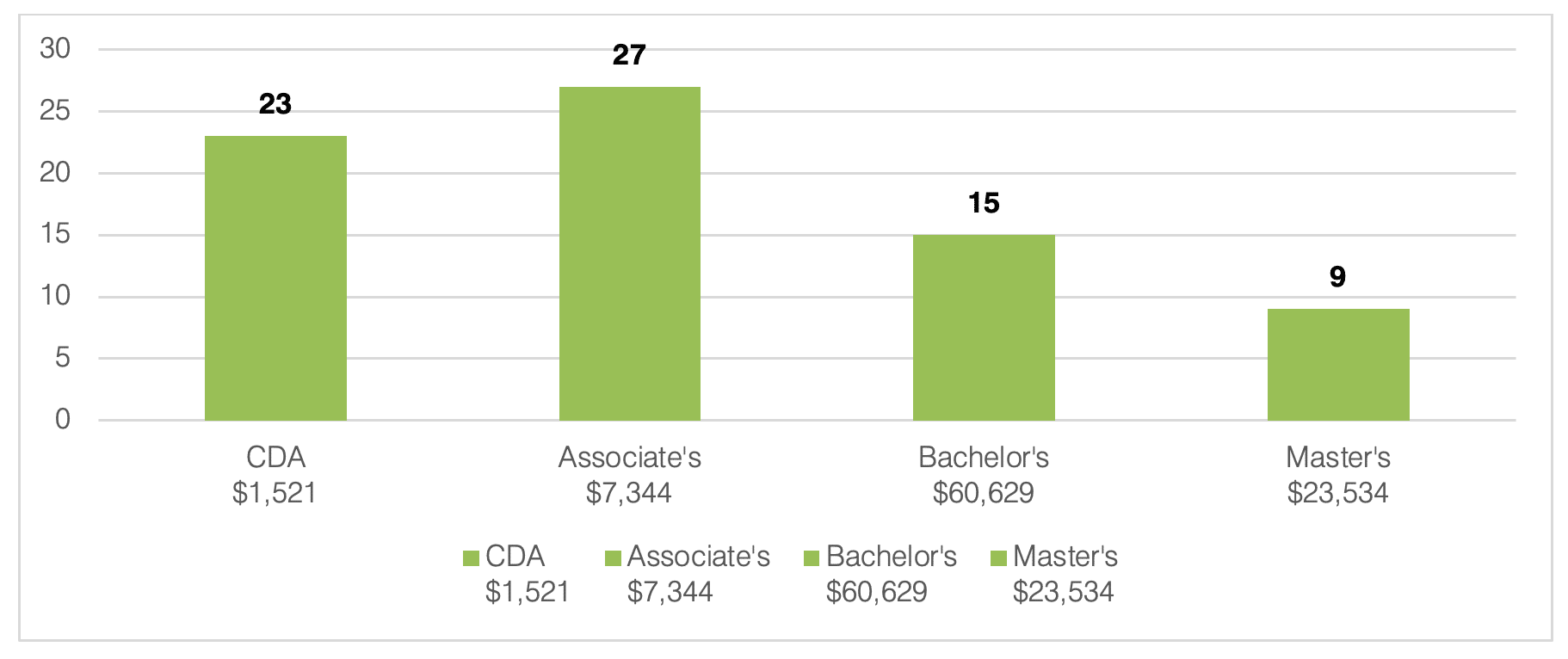
Data from the MIAEYC illustrates the number of early childhood-centered degrees offered throughout Michigan. The most common credential type is an associate’s degree, with 27 colleges or universities offering a degree at an average cost of $7,344.
Number of Early Childhood Education Certifications and Median Program Cost in Michigan
Source: MIAEYC, analysis by PSC