
Brownfields & TIFs
Brownfield projects are contaminated, functionally obsolete, historic resource, or blighted sites that can be rehabilitated through qualifying incentives. Tax increment financing (TIF) is a powerful funding tool that can help cover the additional costs associated with redeveloping a brownfield property.

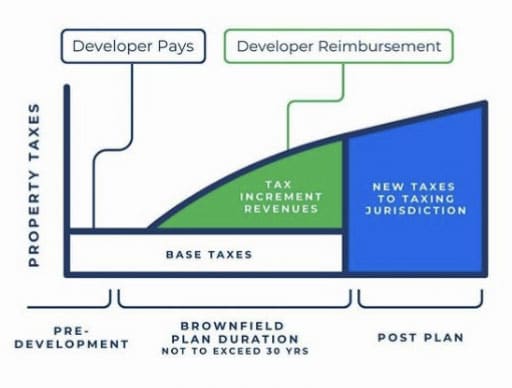
HOW A BROWNFIELD TIF WORKS
Qualifying for A BROWNFIELD PLAN
Under PA 381 of 1996, a contaminated site, or "facility" is just one way to qualify a property as a Brownfield in the state of Michigan.
Other property designations for brownfield properties in Michigan include functionally obsolete, historic resource and blighted. While contamination may exist on many brownfield sites, not all brownfield sites are necessarily contaminated.
Additional resources and information from the State of Michigan can be found at https://www.miplace.org/programs/brownfield-incentives-and-programs/
LOCAL SCHOOL DISTRICTS FUNDED FROM TIR
The taxes that are captured as part of a brownfield plan, as authorized by EGLE, the MSF or both, are intended to reimburse a developer for the costs incurred during the remediation and/ or redevelopment of a brownfield site. These taxes are above and beyond the base level of tax revenue being generated by the unimproved site and represent new revenue that would not exist without the development taking place. The original, base amount of revenue collected prior to the redevelopment project continues to go to schools during the length of the brownfield plan. In addition, improvements to the site increase surrounding property values and encourage other investments that all result in more funding for schools.
Counties report to the state how much tax increment was captured by TIF authorities, including brownfield redevelopment authorities, downtown development authorities (DDA), and local development financing authorities. The local school district is reimbursed annually by the state School Aid Fund.